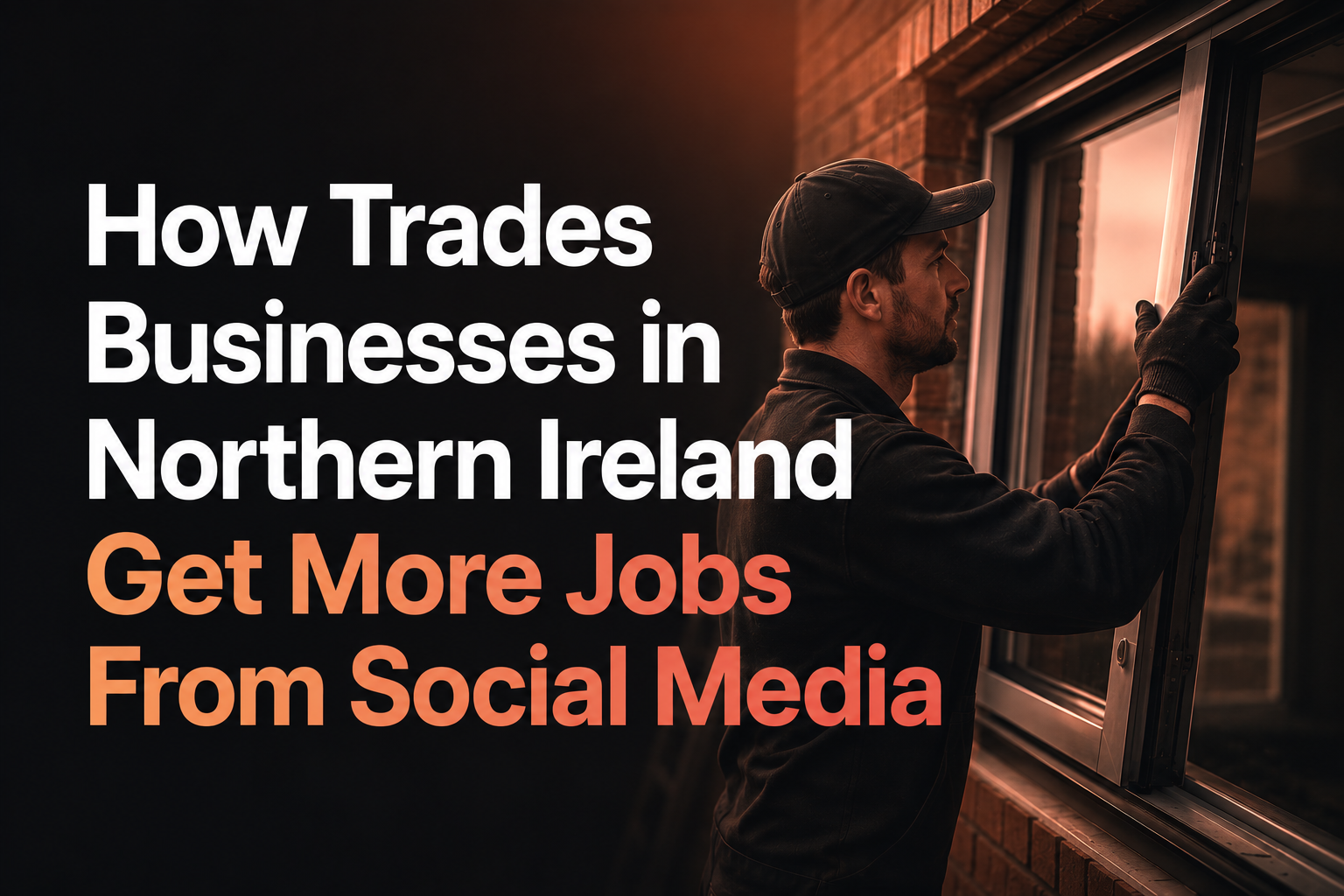
Most trades businesses in Northern Ireland are sitting on a problem they have not fully solved yet. The work is good. The reputation is solid. The diary fills up through referrals and the odd repeat customer. But growth is unpredictable. A quiet January can undo a strong October. And when the referrals dry up even for a few weeks, there is no system to fall back on.
The go-to answer for most tradesmen has been Checkatrade, Bark, or MyBuilder. And while these platforms generate enquiries, they come with a structural problem that most trades businesses do not clock until they have spent months on them. You are renting leads. You are competing against four other tradesmen for the same job. The customer has no reason to choose you over anyone else except price.
This post covers the exact system we use for trades businesses across Northern Ireland and Ireland to generate exclusive, qualified job enquiries from social media and paid ads. Not shared leads. Not referrals you cannot predict. A repeatable pipeline you own.
Why Word of Mouth Keeps Trades Businesses Small
Word of mouth is not a strategy. It is a byproduct of doing good work. And the problem with byproducts is that you cannot control the volume, the timing, or the quality of what comes through.
A trades business that relies entirely on referrals has a ceiling. The ceiling is set by how many happy customers you have and how often those customers happen to speak to someone who needs your service at the same time they are talking about you. That is a narrow window. It also means your growth is entirely dependent on other people's behaviour, conversations you are not in, and timing you cannot influence.
The tradesmen winning in NI right now are not waiting for referrals to land. They are building a system that generates enquiries on demand. Same quality of customer. No dependency on timing or luck. The volume is controlled by their marketing budget, not by how many people happened to mention them at a dinner party last week.
Word of mouth is still valuable. Let it run. But it should be one input into a pipeline, not the entire pipeline.
Why Checkatrade and Bark Are the Wrong Play for Growing Trades Businesses
Checkatrade, Bark, MyBuilder, and similar platforms work on a shared lead model. The platform charges you for an enquiry that has also been sent to three or four other tradesmen simultaneously. The customer fills in a form, gets four phone calls in the next twenty minutes, and picks the one who answered fastest or quoted lowest.
There are three structural problems with this model that compound over time.
First, you are training your market to buy on price. If every time a customer generates an enquiry they get four competing quotes, the market learns that trades work is a commodity to be shopped. You do not want to operate in a commodity market. You want to operate in a trust market where the customer chooses you before they have spoken to anyone else.
Second, the lead quality degrades as the platform scales. When Bark first launched, lead quality was reasonable. As more tradesmen join and compete for the same pool of leads, the platform's incentive to generate volume increases. Quality control decreases. You end up paying for enquiries from people who submitted a form at midnight on a whim and have no intention of booking.
Third, you own nothing. The moment you stop paying for credits or subscriptions, the pipeline stops. There is no compounding. No audience you have built. No brand equity that works for you while you sleep. Every pound spent on these platforms is a rental, not an investment.
The businesses we work with who come from Checkatrade backgrounds have almost universally found that their close rate improves and their cost per closed job decreases when they move to an owned pipeline. Because the customer arrives already trusting them before they have even spoken.
Struggling with social media for your business?
Book a free discovery call and we will show you exactly what we would do in your position.
Request a Free Discovery Call With Our TeamThe System That Actually Works for Trades Businesses in NI
Here is the exact framework we use. It has three components that work together. Content that builds trust before the customer enquires. Paid media that puts that content in front of the right local audience. And a follow-up process that books the survey before the lead goes cold.
The content layer comes first. Not because it generates immediate leads, but because it does the trust work that makes every pound of ad spend more efficient. The content types that work for trades businesses specifically are awareness content that shows the quality and process of the work, before and after content that makes the transformation tangible, and testimonial content from past customers talking about the experience. These three content types map to three stages of the buyer journey. The person who has just started thinking about getting a job done needs to see your work. The person who is evaluating you against alternatives needs to see the before and after. The person who is nearly ready to book needs to hear from someone like them who has already used you.
The paid media layer takes this content and puts it in front of a targeted local audience every single day. Not boosted posts. A structured campaign with audience segmentation, creative testing, and a conversion objective tied to enquiry volume. This is the difference between hoping the algorithm picks up your content and engineering the reach deliberately.
The 3-Stage Trades Lead Funnel
The Lead Form Setup and Why Multi-Step Outperforms Single Opt-In
Most trades businesses who run their own Facebook ads send traffic to a single-field lead form asking for a name and phone number. They get a lot of submissions and a terrible contact rate. The person who fills in a one-click form has made almost no commitment. They submitted their details with the same effort as liking a post. By the time you call them twenty minutes later they have already forgotten they did it.
We use a multi-step lead form for every trades campaign we run. The form asks three to five questions before collecting contact details. What type of work are you looking for. What is the approximate size of the job. When are you looking to get started. What is your postcode.
Each question serves a dual purpose. It qualifies the lead before they enter your pipeline, filtering out tyre-kickers who are not serious. And it increases the psychological commitment of the person filling in the form. By the time they reach the contact details step they have invested two minutes and answered four questions. They are not going to abandon the form at that point. And when you call them, they remember submitting it and they are expecting your call.
The contact rate on multi-step forms versus single opt-in forms in our trades campaigns runs at roughly three to four times higher. The lead volume is slightly lower because some people drop off during the questions. But the leads that do come through are significantly more qualified and significantly easier to convert to a booked survey.
The Follow-Up Process That Converts Enquiries Into Booked Surveys
The follow-up is where most trades businesses lose jobs they should have won. A lead comes in. It sits in an email inbox or a Facebook notifications tab. The tradesman sees it three hours later, sends a message, and gets no reply. The job goes to someone else who called within five minutes.
Speed is the single most important variable in converting a paid lead into a booked survey. Not the quality of your quote. Not how competitive your price is. How fast you pick up the phone after someone has raised their hand.
The system we build for our trades clients has three components. An automated SMS fires within sixty seconds of a form submission. It reads like a personal message, not a template. Something like: just seen your enquiry come through, giving you a call now. At the same time a task is created for the person handling inbound calls to dial the number immediately. Not in an hour. Not after they finish what they are doing. Immediately.
If there is no answer on the first call, a follow-up call goes out two hours later with a second SMS. The following morning if still no contact, a final message goes out. After three touch points across twenty-four hours without a response, the lead is marked as unresponsive and moved on from. Do not chase endlessly. The leads that need chasing beyond three attempts are rarely the jobs worth having.
The person making the calls needs basic training on two things. How to open the conversation in a way that feels personal rather than scripted. And how to qualify quickly whether the job is within the service area, within budget expectations, and within the right timeline before investing time in a survey visit.
The Perfect Lead Follow-Up Sequence
What This Looks Like in Practice: PaintPVC in Newry
PaintPVC is a home improvement company based in Newry targeting homeowners across Dublin. When they came to us they had no social media presence, no inbound leads system, and were relying entirely on word of mouth and referrals to fill their diary.
We built their content strategy in three layers. Awareness content to get their business seen by Dublin homeowners considering home improvement. Before and after content showing the quality of their window and door installations. Customer testimonial content from past clients speaking about the experience and the result.
Once the content system was established, we layered Facebook ads on top to put the entire system in front of a targeted local audience at controlled daily volume. The ads ran to a multi-step lead form that qualified each enquiry before contact details were collected. The follow-up system booked surveys within hours of each enquiry coming in.
In 90 days: 114 enquiries generated. £12.85 per enquiry. 19 jobs closed. £62,700 invoiced. Total ad spend: £1,465. Cost per closed job: £77 against an average invoice value well above £2,500.
The reason those numbers work is not that the ads were particularly clever or the content was particularly polished. It is that every component of the system was built to work together. The content warmed the audience before the ads ran. The ads sent qualified local traffic to a form that filtered tyre-kickers. The follow-up process converted enquiries before they went cold.
Conclusion
Trades businesses in Northern Ireland that are growing predictably in 2026 are not growing on referrals alone. They are building owned pipelines using social media content and paid media to generate exclusive enquiries from their ideal local customers, then converting those enquiries with a fast, structured follow-up process.
The social media for trades businesses model is not complicated. But it requires all three components to be in place simultaneously. Content without ads produces slow, unpredictable growth. Ads without content produce expensive, sceptical clicks. And both without a proper follow-up process produce leads that go cold before anyone picks up the phone.
If you run a trades business in Northern Ireland or Ireland and want to understand what this system would look like for your specific service area and job type, book a free strategy call with Elite Socials. We will review your current situation and show you exactly what the first 30 days would produce.
More From Elite Socials
How Much Does a Social Media Agency Cost in Northern Ireland in 2026?
Wondering what a social media agency costs in Northern Ireland? Here's an honest breakdown of NI agency pricing.
Why Your Social Media Isn't Getting You Customers
If social media isn't getting you customers, here's the real reason why and what local businesses in NI are doing instead.